
The research potential of the IAPT dataset#
Published 19 May 2026
Background#
In 2008 the Improving Access to Psychological Therapies (IAPT) service was launched in England to provide evidence-based, NICE-recommended psychological therapy for adults experiencing anxiety, depression and other related common mental health conditions. Since then, the service has grown significantly in both scope and scale offering employment support, online (digital) treatment options, extending support to people with long term-physical health conditions or medically unexplained symptoms and has over 1 million people accessing the service annually (NHS Digital, 2025).
IAPT – which was re-named to ‘NHS Talking Therapies for Anxiety and Depression’ in 2023 – is the largest publicly funded and systematic implementation of evidence-based psychological care in the world (Wakefield et al., 2021). The model has inspired similar services in countries such as Norway (Knapstad et al., 2020) and Australia (Baigent et al., 2023).
The IAPT dataset contains information about adults in England who are referred to psychological therapy as part of the NHS Talking Therapies for anxiety and depression service. As with all NHS datasets, IAPT data is not collected for research purposes however, it has several features that make it a potentially very useful research resource!
Naturalistic treatment data#
Information is routinely collected from almost all adults accessing NHS psychological therapy for common mental health problems in England. The IAPT dataset therefore provides large-scale, real-world data about referrals, access, waiting times, treatment, and outcomes. This is valuable information for understanding who is accessing treatment and how, what therapy they receive and for evaluating treatment outcomes - for example, outcomes associated with particular therapies (e.g. Cognitive Behaviour Therapy) and outcomes for particular groups of people. Because the information is collected in a standardised way across England, it also enables different geographical areas within the nation to be compared.
Comprehensive coverage#
The IAPT dataset contains hundreds of variables organised into a series of tables that researchers can link together using ‘participant ID’ and/or ‘pathway ID’ (which identifies a particular referral for a person). These tables capture de-identified patient-level information including socio-demographics, employment and benefit details, care pathway (referral, appointments, treatment type) and patient outcomes for each referral received. Example variables that may be of interest to mental health researchers are shown below:
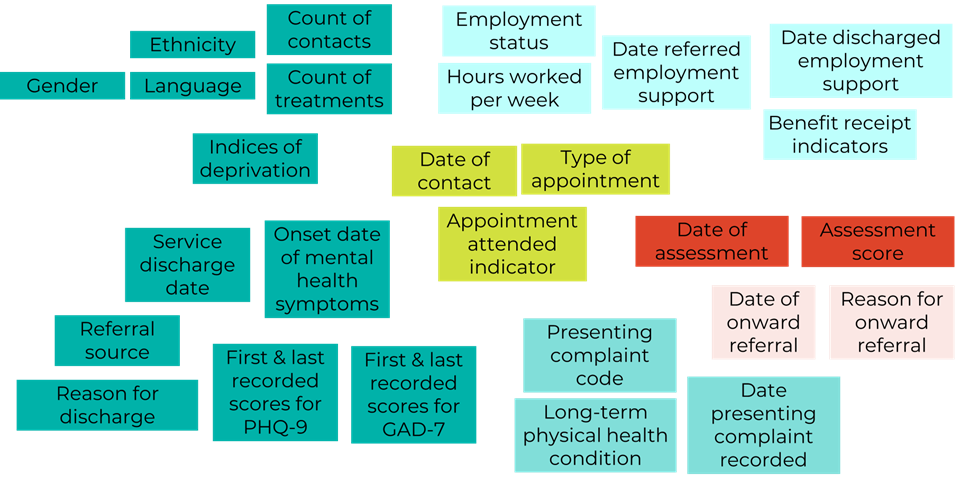
Data is longitudinal, spanning from referral to service discharge allowing researchers to track patients’ journey through their treatment. Some people may access psychological therapy on more than one occasion and therefore have multiple referrals and episodes of treatment over time which allows patterns of care and re-referral for individuals over longer periods of time to be examined.
Repeated measures of symptoms using standardised and validated measures#
A key feature of the NHS Talking Therapies service is the systematic use of routine outcome monitoring. Patients complete a standardised set of self-report measures of their symptoms (see below) on a session-to-session basis during treatment. These repeated measures enable researchers to assess symptom trajectories over the course of treatment.
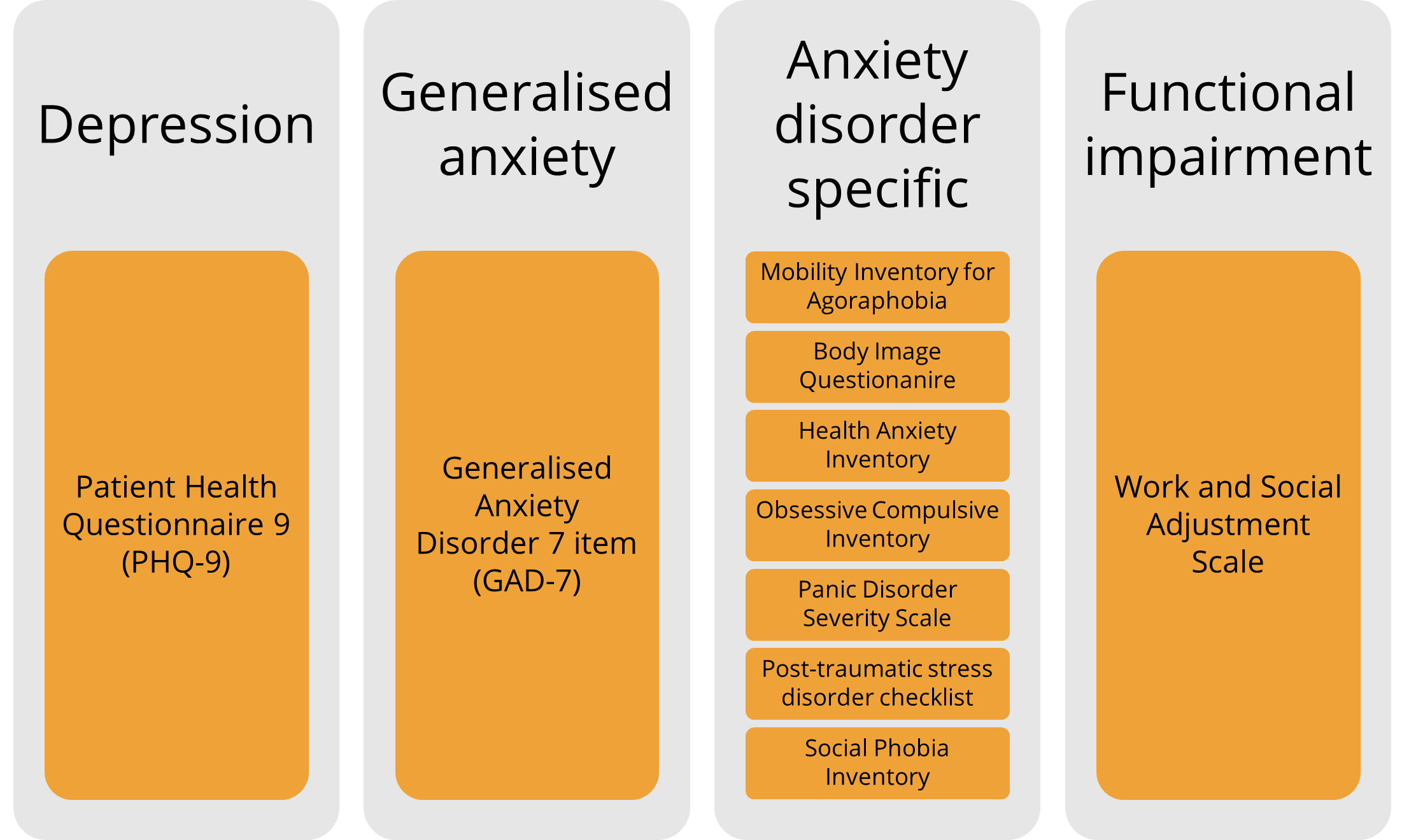
NHS Talking Therapies for anxiety and depression main outcome measures for anxiety, depression, specific anxiety disorders, and functional impairment
Importantly, instead of relying on an outcome measured only at the end of treatment, measuring symptoms at every session ensures there is a last available score that can be used for outcome monitoring even if the treatment ends unexpectedly early. NHS England reports that that outcome data is obtained for 98.5% of all patients who have a course of treatment (NHS England, 2024). Pairing patients’ first and last symptom scores then allows key patient outcome metrics such as recovery, reliable improvement, reliable deterioration and no reliable change to be determined.
Research using the IAPT dataset#
Existing research has utilised the IAPT dataset – at both national and local levels – to explore a range of topics, including:
Inequalities in accessing psychological therapy (e.g. Sharland et al., 2023; Bamrah et al., 2025).
Trajectories of symptom severity during psychological therapy (e.g. Saunders et al., 2019; Skelton et al., 2022)
Determinants of variability in treatment response (e.g. Rimes et al., 2019; Saunders et al., 2021; Stochl et al., 2021; Amati et al., 2023).
Linkage of the IAPT dataset with UK LLC’s partner LPS participants presents a unique opportunity to explore even more exciting research questions!